
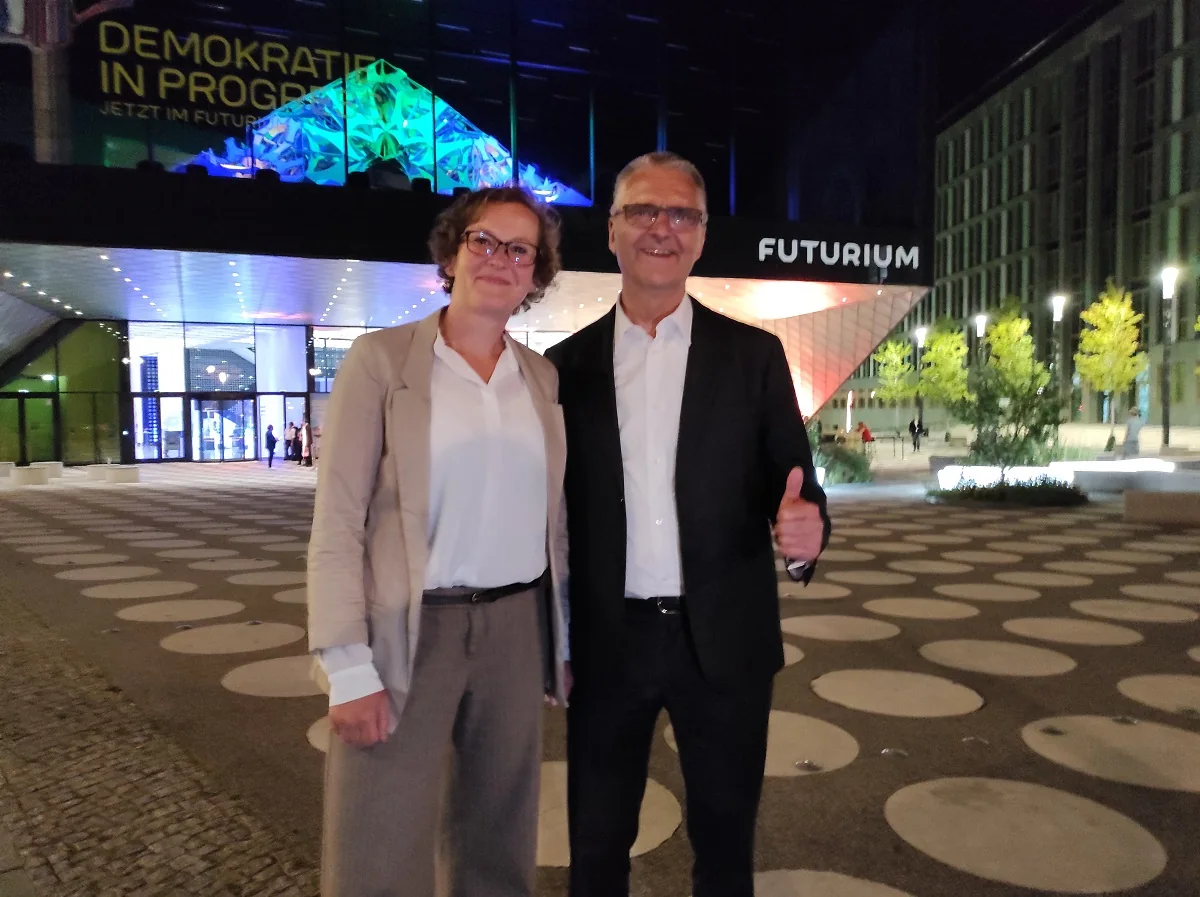
Highly interesting discussions accompanied the VATM anniversary celebration in Berlin. Representatives of the member companies from telecommunications, politics as well as current and former heads of the Federal Network Agency and the former post office made the event a really varied day.
Central topics included the superstructure in the fiber optic area and the complex approval procedures.
The liberalization of the Telco market
The liberalization of telecommunications was probably the biggest and most successful reform of all, said David Zimmer, VATM President at the opening. And many panelists confirmed this throughout the day. It took a lot of courage to close an entire ministry - at that time the Deutsche Bundespost -, adapt the basic law and open the market to other participants.
This was a round of discussions by Dr. Frederic Ufer, 2nd Managing Director of VATM, with the former presidents of the Federal Network Agency and the Postal Ministry about their experiences back then, which was very entertaining. You could literally feel the spirit of optimism at the time and the courageous decisions that characterized the time.
Before liberalization, households received a telephone from the Deutsche Bundespost for which they had to pay a lot of money per month. Own devices were not allowed and even violated the constitution.
VATM: Fair conditions for everyone
The principle “fair conditions for all” was coined when the VATM was founded 25 years ago. And the association has maintained this to this day. With a lot of commitment and the motto of not giving up, Jürgen Grützner, managing director of VATM, and his team have achieved a lot. They were motivated to continue in the same way and advocate for fairness in the telecommunications market. Even though there were always heated discussions, Stefan Schnorr, State Secretary of the Federal Ministry for Digital Affairs and Transport, also welcomed the constructive meetings with the VATM. In the end, everyone wants the same thing and that is to advance digitalization in our country. David Zimmer said at the beginning that the guest list exactly reflected the explosiveness of the topic.
Fair conditions are particularly important in the area of superstructure. In metropolitan areas we are talking about overbuilding while rural regions are still struggling with white spots. There are around 700 network expansion companies in Germany that are trying to solve exactly that. The network operators also expand less lucrative areas, as long as the lucrative ones in a community are included. However, in the last few months, some projects have lost their economic viability because Deutsche Telekom subsequently became active there through superstructure. Unfortunately, it often only builds in the profitable areas, leaving the other areas behind. Here, those involved want faster options for action in order to keep fair competition alive.
Dr. Sören Trebst, CEO of 1&1 Versatel GmbH, once again raised concerns that, given the current situation, remonopolarization by 2030 is even on the cards again. What is needed here are clear rules and the intervention of the regulator in the superstructure. It also became clear that planning security is essential for companies expanding the network and especially in non-subsidized areas. Only hand in hand can they manage the nationwide expansion and, above all, connect rural regions. Jürgen Grützner advocated giving permission for an entire area and only letting the excavator move again when the last house at the end of the street was connected.
More or less regulation?
In the discussions, calls for more regulation to make competition fairer came up again and again. But Jochen Homannn, former President of the Federal Network Agency from 2012 to 2022, also said that the regulatory authority cannot dictate everything. The network operators also have to come to an agreement among themselves. Rickmann v. Platen, CCO of Internet AG, later added on the topic that regulations are also needed if agreement cannot be reached. In his opinion, regulation started strong because back then there was a level playing field for service providers. Today, however, the service provider tends to stand in the way of the network operator. This also leads to network utilization.
Bureaucracy and long approval procedures
Everyone agreed that bureaucracy stands in the way of rapid digitalization. Markus Hendrich, CEO of ecotel communication ag, added that customers also expect fast service. Approval procedures of up to five years, which would ultimately have a positive decision anyway, but are contrary to this. With 700 companies expanding the network, 700 contracts are also necessary in order to be able to communicate with each other. Standards are urgently needed here. Those involved would like to finally have a digital construction file across national borders. Stefan Schnorr assured that they were on it. He also sees this as important.
The future will be even more exciting than the past
As turbulent as the last 25 years have been, market participants and the VATM see an even more turbulent future. During the panels, the participants expressed different wishes, from the digital building permit, to Telekom purchasing bitstream from all market participants, to homogeneous clusters for fiber optic expansion and to extending existing frequencies instead of auctioning them off.
We hope for a good future in telecommunications, perseverance from everyone and thank you for the extremely interesting and varied day in Berlin.
The founding of dimari GmbH goes back to liberalization
With the liberalization of the telecommunications market, the roots for the founding of dimari GmbH were laid. As early as 2002, Diethard Kumpf, managing director of dimari, recognized that the many new network operators needed software to manage and bill customers. Systems back then were too expensive. With the varioSuite, municipal utilities, carriers and mobile operators can map the end-to-end process and precisely manage and bill telecommunications products.